Driveway Pavers Los Angeles
Paver driveways in Los Angeles. Concrete, travertine, porcelain. Flat and sloped driveways. Proper base for vehicle loads.
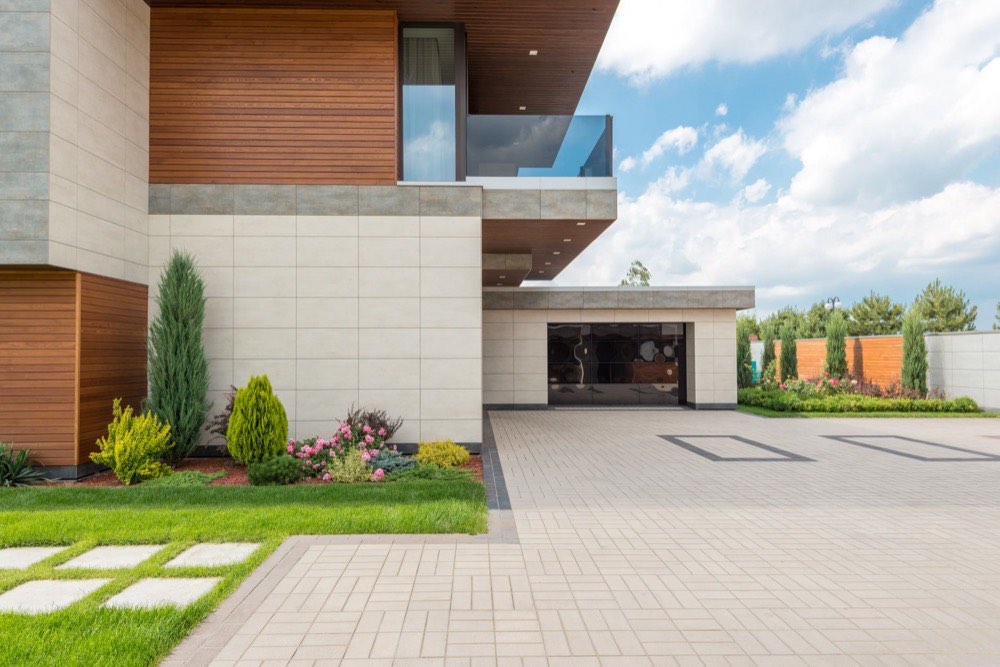
A paver driveway is a structural installation. Vehicle loads, thermal cycling, and drainage demands require heavier base specification than pedestrian areas – typically 8–10 inches of compacted aggregate versus 4–6 for patios. Getting that base specification right is what separates a driveway that holds up for 20 years from one that develops ruts and settlement within the first few seasons. Vehicle traffic, oil, and repeated thermal cycling put demands on the surface and base that pedestrian areas don’t see. Getting the base specification right for driveway applications is what separates a surface that holds up from one that develops problems within a few years.
We install paver driveways throughout Los Angeles – from standard residential approaches to large motor courts and sloped hillside entries.
Driveway Paver Installation
The installation process for driveways follows the same sequence as other paver work – excavation, base, bedding sand, pavers, edge restraints, joint sand – but with heavier base specifications to handle vehicle loads.
For a standard residential driveway:
- Excavation depth: 8–10 inches
- Compacted aggregate base: 6–8 inches
- Bedding sand: 1 inch
- Paver thickness: minimum 2 3/8 inches (60mm) for vehicular applications
Thinner pavers (40mm) are appropriate for pedestrian areas but will crack under vehicle loads over time. We specify the right product for the application.
Driveway Paver Materials
Concrete Pavers
Most common for driveways. Durable, available in a wide range of sizes and colors, cost-effective. Handles vehicle loads well when properly installed. Can be repaired section by section if needed.
Travertine
Popular for high-end residential driveways. Natural stone appearance, cool underfoot, holds up well in the LA climate. More expensive than concrete; requires proper sealing on driveways to prevent oil staining.
Porcelain
Modern, low-maintenance, consistent appearance. Works well on flat driveways. Requires larger format tiles and careful cutting. Not ideal for steep slopes due to surface texture considerations.
Brick
Traditional look, extremely durable. Less common in LA than in other markets but appropriate for certain architectural styles.
Sloped Driveways
Hillside properties present specific challenges for driveway paver installation. A sloped surface requires:
- Proper surface drainage to prevent water from channeling down the slope
- Adequate edge restraint at the downhill edge to prevent migration
- Appropriate paver pattern and texture for traction
- Sometimes channel drains at the base of the slope
We’ve installed paver driveways on steep hillside lots throughout the Santa Monica Mountains, Bel Air, and the hillside neighborhoods of Glendale and Pasadena. Slope work adds complexity and cost but is entirely manageable with the right approach.
Driveway Paver Cost in Los Angeles
Typical ranges for driveway paver installation in Los Angeles:
- Concrete pavers: $20–$30 per square foot installed
- Travertine: $25–$40 per square foot installed
- Porcelain: $28–$45 per square foot installed
The main cost variables beyond material are grade changes, retaining walls, drainage work, and existing surface removal. A flat driveway replacement is a simpler scope than a sloped entry with a retaining wall and channel drain.
We provide itemized proposals so you understand exactly what’s included.
What Causes Driveway Paver Failures
Driveway failures are almost always base failures – not material failures.
- Underbuilt base – patio-spec base (4″) used on a driveway application that needs 8–10″
- No geogrid on soft soil – expansive clay soils common in parts of LA require stabilization
- Edge restraints missed at curb transitions – pavers at street edge spread without restraint
- Drainage not established at grade – water channels down the slope and undermines base at the low end
Frequently Asked Questions
How do paver driveways compare to concrete or asphalt?
Paver driveways cost more upfront but offer advantages in repairability – individual pavers can be lifted and replaced without visible patches – and appearance. They hold up comparably to concrete in the LA climate. Asphalt is less expensive but has a shorter lifespan and deteriorates from UV exposure and oil penetration faster in hot climates.
Will my paver driveway crack?
Individual pavers can crack from point loading (vehicle jacks, heavy equipment), but a paver surface distributes load across multiple units and generally handles settlement better than monolithic concrete, which cracks in long sections. If a paver cracks, it can be replaced individually without disturbing the rest of the surface.
Can I park heavy vehicles on paver driveways?
Yes, with appropriate base specification. RVs and heavy trucks require deeper base depth and sometimes geogrid reinforcement. Tell us during the estimate if you have vehicles over standard passenger car weight.
Serving: Los Angeles · San Fernando Valley · Westside · Pasadena · Glendale · LA County